
Blog: The Houthis, a shared threat for Israel and Saudi Arabia
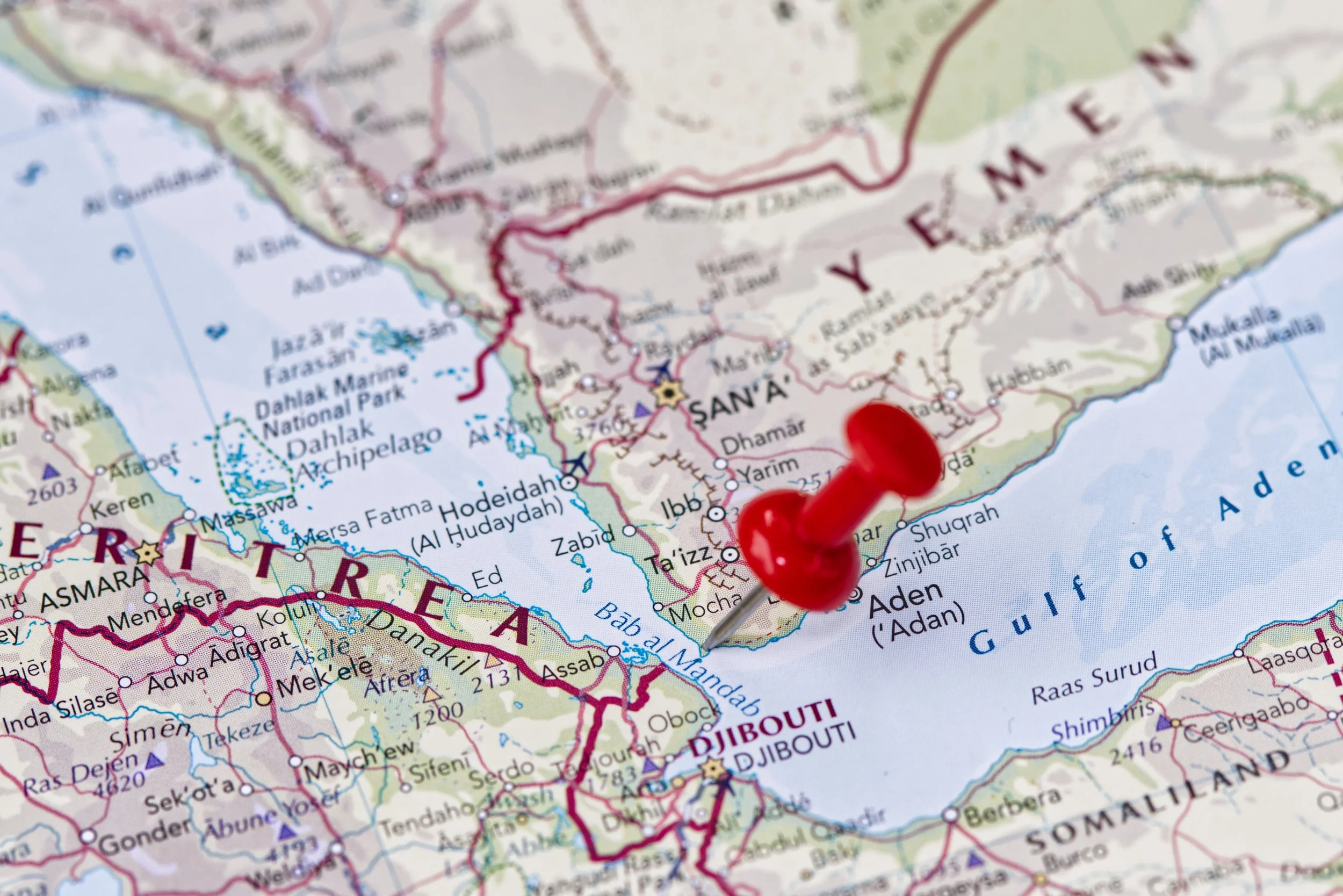
As the UK agrees to deploy RAF Typhoon jets to defend Saudi Arabia against Houthi missile and drone attacks we explore how the Middle East enters another phase of conflict post October 7. Examining how the fall-out from the Iran war, and Iran’s most powerful and last standing proxy, is shaping ongoing regional crisis. The legacy of the direct conflict between Iran, Israel and the US is restriction to freedom of navigation, both in the Strait of Hormuz, and the Bab al-Mandab Strait - something which of political concern in the west, given its impact on oil prices and the cost of living.
For context in 2023, led by the US Biden administration, Israel and Saudi Arabia were reportedly involved in serious discussions regarding normalising ties and were widely considered on the cusp of a historic agreement. However, the October 7 Hamas massacre abruptly felled these talks. Without a Palestinian state, it is understood, there will be no normalisation from the perspective of Saudi Arabia.
The Houthis have not had a ‘career limiting’ post October 7 confrontation with Israel unlike Hamas and Hezbollah; in fact through various phases of confrontation with the US and Saudi Arabia over a decade they have gone from strength to strength. We’ll take a look at hoe the Houthis have become such an unstoppable, sophisticated, and highly armed professional fighting force that has proven to be invaluable in aiding Iran in its time of need and how this may impact Israel-Saudi relations.
Who are the Houthis?
The Houthis are an Iranian-backed political and religious militant group, originating from a branch of Shia Islam (Zaydism) rooted in Yemen’s northern highlands in the 1990s, formally known as ‘Ansar Allah’ meaning “supporters of god”. Zaydis are a religious minority that traditionally only had a stronghold in the north of Yemen. They believe that political and religious leadership belongs exclusively to descendants of the Prophet. They differ significantly from Iranian Shiism, “the Houthis have made fighting corruption the centerpiece of their political program, at least nominally. The Zaydi do not believe in ayatollahs like the Twelver Shiites—who are the Shiite sect in Iran and most of the Muslim world—nor do they practice the other Twelver doctrine of taqqiyah (dissimulation), which permits one to disguise his or her faith for self-protection.”
Under former leader and founder Hussein Badreddin al-Houthi the Houthis became more focussed on their marginalisation within Yemen and shifted towards political activism. The US invasion of Iraq in 2003 deeply radicalised the Houthi movement, and led to the adoption of the slogan “god is great, death to the US, death to Israel, curse the Jews, and victory for Islam”.
Iranian support began during the Houthi uprising against the Yemeni government, with some experts estimating support from Iran began as early as 2009. Iran is now the Houthis primary benefactor, providing them with security assistance, weapons transfers, military training and intelligence.
Whilst the Houthis are not yet a proscribed terrorist organisation in the UK – despite previous British military campaigns against the militant group – the US, Canada, Australia and New Zealand have all designated the Houthis a terror group.
The Saudi-Houthi enmity: a brief history
2000: On 12 June, a landmark agreement known as the Treaty of Jeddah was signed between Saudi Arabia and Yemen, resolving a long term border dispute between the two nations. By formally deepening ties with Saudi Arabia, this became part of the political backdrop that shaped the emergence and growth of the Houthi movement.
2004: The Houthis began an uprising against the Saudi government run by President Ali Abdullah Saleh, accusing him of corruption, marginalisation, and allowing excessive Saudi influence in Yemen – including religious Sunni beliefs. Houthi founder Badreddin al-Houthi was killed by government forces.
2004-2010: The Houthis fought six wars against Saleh’s government, gradually becoming a significant military force. During this time, the Houthis accused Saudi Arabia of pressuring Saleh to take action against their community and of providing him with financial support.
2011-2012: During the Arab Spring, mass protests forced Saleh to stand down and he was replaced by his deputy, Abdu Mansour Hadi, under a Gulf-backed transition plan. However, the transition was weak, the economy deteriorated, and many Yemenis became dissatisfied with Hadi’s government.
2014: On 21 September, the Houthis captured Sana’a, Yemen’s capital, becoming the de facto rulers of most of Yemen’s population and formally beginning the Yemeni civil war. The successful takeover signalled to the international community that the Houthis had evolved from a local insurgency into an increasingly powerful military force that could no longer be ignored.
2015: After facing heightened conflict and civil unrest, Hadi fled to Riyadh, Saudi Arabia in March 2015. The conflict was internationalised with the entry of a Saudi-led coalition (which included the UAE, Egypt, Morocco, Jordan, Bahrain, Sudan and Kuwait), in support of the ousted President. The coalition imposed a full naval and aerial blockade on Yemen, to prevent Iran from supplying the Houthis with weapons.
2015-2022: The war became a stalemate. Saudi-led strikes failed to defeat the Houthis, whilst the Houthis launched missile and drone attacks into Saudi Arabia. Between 2015 – 2018 alone it is estimated that 85,000 children starved to death as a result of the Saudi-led blockade. During the fighting, the Houthis consolidated their control over much of northern Yemen, including Sana’a.
2022: On 2 April, a six month UN-brokered ceasefire came into effect and sharply reduced fighting. Saudi Arabia gradually shifted towards negotiations with the Houthis rather than seeking outright military victory – though a final peace agreement has never been properly implemented. Since then, Yemen has effectively been divided, part controlled by the Houthis and part controlled by the Saudi-backed internationally recognised government.
2023: Nearly six million Yemenis have been displaced by the conflict and more than 23.4 million need humanitarian assistance.
2025: The conflict created one of the world’s worst humanitarian crises, with an enduring legacy, nearly 20 million people it is estimated are in need of humanitarian assistance and protection as of 2025, 76% of which are women and children.
Israel and Saudi Arabia: a growing convergence of interests
1. Secure maritime freedom of navigation
The Houthis have come to the aid of their Iranian benefactors at a critical time. Just as the US midterms approach and with it the pressure on President Trump to wrap up the war with Iran, the Houthis have found a way to exert pressure on international oil prices and strengthened Iran’s negotiating hand.
On 20 July 2026, in response to the alleged Saudi strikes on Sana’a International Airport, the Houthis declared a “maritime blockade against the criminal Saudi enemy based on the equation of an eye for an eye”. The militant group began attacking Saudi-linked vessels transiting the Red Sea, justifying the legitimacy of the blockade by arguing that Saudi Arabia had long restricted maritime and air access to Yemen to prevent Iranian weapons from reaching the Houthis.
On 10 September, the Houthis escalated their maritime campaign, seizing control of the major port city of Mocha in the Red Sea. By the following day, they had completed their takeover of the vital Bab el-Mandeb Strait by capturing several strategic islands along the coastline – completing a week-long offensive that reportedly left hundreds dead.
Saudi Arabia is considered the largest global exporter of oil, accounting for approximately 20-30% of the country’s GDP. After the closure of the Strait of Hormuz earlier this year, the Bab el-Mandeb Strait has become a vital maritime chokepoint for Saudi oil exports; the Houthis have been under significant pressure from Iran to close off Bab el-Mandeb to Saudi oil tankers that were diverting exports away from the Gulf. Since the Houthis seized control of the Red Sea coastline, Saudi energy security and maritime trade routes are under significant threat – especially given the damage to the major East-West pipeline after an attack by Iraqi militias in mid-September.
Located at the northern tip of the Red Sea, the Port of Eilat is a vital southern maritime gateway connecting Israel to Asian trading markets – accounting for almost a quarter of Israel’s total foreign exports, and nearly a third of Israel’s foreign imports. The Bab el-Mandeb Strait, which connects the Red Sea to the Gulf of Aden, determines whether trade flows freely between Israel and various Asian countries, or experiences instability.
Whilst a significant portion of Israel’s trade takes place via its Mediterranean ports such as Haifa and Ashdod, the Port of Eilat acts as a necessary strategic alternative gateway should the Mediterranean ports come under threat – a scenario whose likelihood increases in the event of large-scale conflict with Hezbollah or Iran, as we have seen throughout the last year.
The Houthi takeover of the Bab el-Mandeb Strait provides the group the ability to exert direct influence over one of Israel's most important maritime trade routes. Even if commercial traffic is not completely halted, the threat of missile, drone, or naval attacks increases shipping costs and transit times for vessels travelling to and from Israeli ports. In practice, the Houthis don’t need to permanently close the waterway to impose significant economic and strategic costs on Israel; the credible threat of disruption alone can alter commercial shipping patterns and undermine confidence in the security of Red Sea trade.
For both Israel and Saudi Arabia, the Red Sea is both a strategic vulnerability and an opportunity. They share an interest in protecting freedom of navigation through its waters and containing Iranian influence there, and face significant costs from maritime disruption.
2. Protecting against direct missile attacks
The Iran war to date has left a regime that is willing and able to go beyond previous red lines. An Iran willing to attack Arab nations (including Bahrain, Qatar, Jordan, Oman and the UAE), with damaging consequences for regional economies, alongside western economies dependent on global oil prices.
Since the outbreak of war following the October 7 massacre in 2023, the Houthis have aligned themselves with Hamas, launching a series of missile and drone attacks against Israel in solidarity – including a direct hit next to Ben Gurion Airport in May 2025. Israel responded to these strikes, with targets including the port city of Hodeidah, and Sana’a International Airport. Whilst the Houthis lack the capacity to entirely defeat Israel militarily, continued support from both Iran and Hezbollah have effectively erased the strategic distance between Yemen and Israel and allowed the Houthis to “expand the geographic scope of confrontation” through “long-range ballistic missiles, cruise missiles, advanced UAVs, and maritime strike capabilities”.
For Saudi Arabia, the threat of Houthi missiles has been ongoing since the Saudi-led coalition was implemented in 2015 – though this threat level diminished considerably following the establishment of the UN-brokered truce in 2022. However, following more than four years of relative calm, renewed airstrikes in July 2026 signalled the collapse of a fragile period of de-escalation.
On 13 July 2026, amid the US-Israel-Iran war, the Saudi-backed Yemeni government reportedly struck Sana’a International Airport in order to prevent an Iranian plane from landing in the capital – which was returning home a Houthi delegation from the funeral of former Iranian Ayatollah Ali Khamenei. However, since the Yemeni administration lacks a functioning air force, a Houthi spokesman accused Saudi Arabia of initiating the attack.
The potential resumption of an airbridge between Iran and its Houthi proxy in Yemen has raised concerns across the Middle East.
The Houthis continue to target Riyadh, drones south of Mecca have been shot down; the port city of Yanbu has also been targeted – successfully shutting down two major Saudi airports on 8 October 2026, and again just days later in two consecutive attacks that reportedly killed a combined total of at least 13 people and injured more than 300.
3. Limit Iranian influence and strengthen wider regional stability
The Houthis have served Iran well to create a pincer movement between the Strait of Hormuz and Bab el-Mandeb Strait, successfully applying pressure on President Trump before the US midterms with knock-on effects such as Trump’s Russian diesel deal.
Countering Iranian influence remains a central security objective for Israel and Saudi Arabia. Although the two states face distinct threats, Iran’s network of regional partners and proxy groups directly threaten their national and regional security interests.
Iran’s proxy network is expansive. However, after the October 7 massacre and ensuing conflict, Israel set about destroying the capabilities of Iranian proxies – with particular success regarding Hamas in Gaza, Hezbollah in Lebanon, and the collapse of the Assad regime in Syria. With the Axis of Resistance significantly weakened, this has left room for the Houthis to emerge as arguably Iran’s most powerful and effective proxy group – receiving significant Iranian financial and military support.
Since the 1979 Iranian Revolution, ‘Death to Israel’ has emerged as part of official political discourse in the new Islamic Republic, becoming a critical component of its foreign policy. The slogan has frequently appeared at state-sponsored events, demonstrations, Quds Day rallies and official ceremonies, and has subsequently been adopted by Iran’s network of regional partners who are also committee to resisting Israeli influence.
Likewise for Saudi Arabia, relations with Iran began to deteriorate following the 1979 Iranian Revolution, though this was a more gradual breakdown than was experienced by Israel. These decades-old tensions have only been exacerbated by religious differences, creating an opportunity for a broader Shia-Sunni competition for power – Iran is largely Shia Muslim, whilst Saudi Arabia considers itself a leading Sunni Muslim power.
The 2003 US-led invasion of Iraq solidified the Saudi-Iranian rivalry. Iraqi President Saddam Hussein was removed from power, which eliminated Iraq as an anti-Iranian counterweight in the region and increased Iranian influence inside the country.
Will the Houthis be the authors of a meaningful Israel-Saudi defence partnership?
The conflict between Saudi Arabia and the Houthis has entered a new and potentially more dangerous phase, particularly after the internationally recognised Yemeni government confirmed the launch of a major military campaign against the Houthis on 4 October 2026. Since the collapse of Saudi-Houthi de-escalation period in July 2026, both sides have resumed sustained military operations and increased the prospect of wider regional confrontation. The unprecedented frequency and strength of Houthi strikes against Saudi airports and energy infrastructure in recent weeks – including an attack on oil giant Saudi Aramco’s headquarters on 13 October – has increased pressure on the Kingdom to respond more forcefully to protect critical economic and security interests.
More broadly, Saudi Arabia’s reluctance for overt cooperation with Israel was highlighted after Crown Prince Mohammed bin Salman rejected Netanyahu’s bid for Israel to join the fight against the Houthis following the string of airport attacks in October 2026. Despite the clear convergence of security interests, the decision was reportedly driven by concerns of likely domestic backlash among Saudi Arabia’s population.
Whilst the US has historically positioned itself as Saudi Arabia’s primary security partner, Trump has so far refrained from joining the conflict, and will likely continue with verbal threats alone until after the November US mid-term elections. Recent reports also indicate that the US is holding back due to a dwindling missile stockpile which was severely depleted during the ongoing war with Iran. It remains unclear if and when the US will get involved.
On 30 September 2026, a Flydubai plane transporting 174 passengers from the UAE to Israel underwent an attempted hijacking in which the captain was stabbed. Saudi Arabia opened its airspace and allowed the plane to make an emergency landing in Tabuk, in what briefly appeared to offer an opportunity for closer Israeli-Saudi cooperation. However, the Kingdom refused Israel’s request to send its own aircraft to repatriate the passengers and instead a replacement Flydubai plane bought them home.
Some analysts suggest that Saudi Arabia is waiting until after Israel’s October elections before pursuing military cooperation against the Houthis, with bin Salman instead focused on securing support from elsewhere – particularly from the US – until Netanyahu’s future position is made certain.
On 7 August 2026, Saudi Arabia, Turkey and Pakistan signed a landmark joint defence deal known as the ‘Mecca Agreement’, stating that an armed attack against any of the three states would be regarded as an attack against them all. The agreement suggests that whilst Saudi Arabia is seeking to strengthen its regional security architecture, it is currently prioritising partnerships with fellow Muslim powers rather than bringing its relationship with Israel into the open.
Conclusion – normalisation or alignment
The Houthis have evolved from a localised Yemeni insurgency into one of the Middle East's most influential non-state actors. Backed by Iranian funding, weapons transfers, military training and intelligence support, the group now possesses the ability to threaten territory, disrupt maritime trade and shape regional security dynamics far beyond Yemen's borders. For both Israel and Saudi Arabia, the Houthis represent more than an isolated security challenge. The group sits at the intersection of three shared threats: maritime security in the Red Sea, missile and drone attacks, and Iranian influence across the region. The Houthi threat has therefore created a convergence of interests between Israel and Saudi Arabia. From a Saudi perspective, containing the Houthis is essential not only for national security, but also for the success of Saudi Vision 2030. The Kingdom’s ambition to transform its western coastline into a major centre for tourism, investment and global commerce depends upon maritime security, robust infrastructure, regional stability and freedom of navigation through the Red Sea.
Likewise, Israel has a strong interest in preventing the emergence of an Iranian-aligned actor capable of threatening both its territory and its access to international trade routes. As the Houthis continue to expand their missile, drone and maritime capabilities, they have become an increasingly important component of Iran's wider regional strategy. While the Houthi threat alone is unlikely to produce formal Israeli-Saudi normalisation, it reinforces the broader strategic rationale behind closer cooperation between Israel and Saudi Arabia – and the United States, a critical diplomatic actor. Shared security concerns create incentives for intelligence sharing, military coordination and joint efforts to counter Iranian influence.
Progress on the Palestinian question is likely to play a far greater role in determining the future of Israeli-Saudi relations than the Houthi threat itself. According to President Trump, the US-Saudi nuclear agreement, signed in July 2026, remains contingent on whether Saudi Arabia agree to Israeli normalisation – which Saudi Arabia have acknowledged will only happen upon Israeli recognition of a Palestinian state.
Whilst the Houthis may not be the catalyst that ultimately delivers normalisation, they have certainly emerged as one of the clearest examples of how common security threats can encourage greater strategic alignment between Israel and Saudi Arabia.